The Fractured Hour: How Meeting Culture and Documentation Creep Are Quietly Dismantling Scientific Productivity in American Biotech
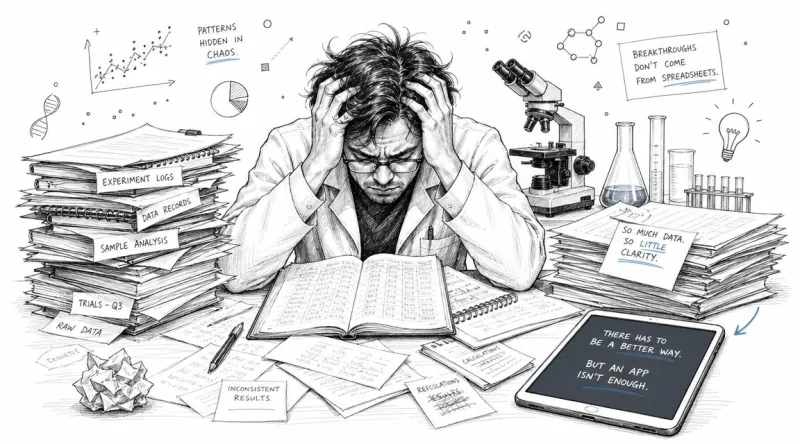
Photo: scientist overwhelmed paperwork laboratory meeting biotech research, via www.wondermentapps.com
There is a particular kind of exhaustion familiar to researchers working inside mid-to-large biotech organizations. It is not the fatigue that follows a demanding experiment or a night spent analyzing data. It is the dull, accumulated weariness of a scientist who has spent most of the day in conference rooms, on video calls, and composing status updates for stakeholders who may never read them—only to arrive at the bench, or the computational terminal, with forty-five minutes remaining before the next obligation begins.
This is the communication overhead problem, and it is quietly reshaping the economics of American drug discovery in ways that balance sheets rarely capture.
When Coordination Becomes the Work Itself
The organizational logic behind cross-functional communication is sound in principle. Drug development is a deeply interdisciplinary endeavor. Biologists, chemists, clinicians, regulatory specialists, and commercial strategists must remain aligned if a molecule is to survive the journey from hypothesis to approved therapy. Coordination is not optional—it is structural.
But coordination has a cost, and in many organizations that cost has grown well beyond what the underlying science requires. A 2023 survey conducted by a life sciences workforce consultancy found that research scientists at US biotech companies with more than 500 employees reported spending, on average, 42 percent of their working week in meetings or preparing materials for meetings. A separate analysis of calendar data from a cohort of senior researchers at three publicly traded biotechs found that blocks of uninterrupted time exceeding ninety minutes—the threshold many cognitive scientists associate with meaningful deep work—occurred fewer than twice per week for most participants.
The implications extend beyond individual frustration. Scientific insight is not a linear output. It emerges from sustained engagement with complex problems, from the kind of iterative, immersive thinking that cannot be scheduled in thirty-minute increments between standing syncs. When that time is fragmented, the quality of the science suffers in ways that are real but difficult to quantify—and therefore easy to ignore until the consequences arrive in the form of failed trials, missed hypotheses, and attrition among the researchers an organization most needs to retain.
The Documentation Burden No One Voted For
Meetings represent only one dimension of the problem. Alongside the proliferation of scheduled calls has come an expansion of documentation requirements that many scientists describe as disconnected from any productive scientific purpose.
Regulatory compliance imposes legitimate documentation obligations, and no serious researcher disputes their necessity. What has grown alongside those obligations, however, is a secondary layer of internal reporting—weekly progress summaries, cross-departmental briefing decks, project management platform updates, and executive dashboard inputs—that collectively consume hours that could otherwise be directed toward the work those documents purport to describe.
One research director at a clinical-stage oncology company, speaking on background, estimated that her team produced approximately twelve hours of internal documentation per researcher per week. "We are writing about science instead of doing it," she said. "And the strange thing is that most of this content is never meaningfully reviewed. It exists to demonstrate alignment, not to advance discovery."
This distinction—between documentation that serves the science and documentation that serves the appearance of organizational coherence—is one that forward-thinking biotech leaders are beginning to take seriously.
Focus Windows and the Architecture of Deep Work
Some organizations have moved beyond diagnosis and into intervention. The approaches vary in their specifics but share a common premise: that protecting uninterrupted research time requires structural commitment, not individual willpower.
One mid-sized gene therapy company based in the Research Triangle region of North Carolina implemented what its leadership calls a "focus window" policy in early 2022. Under this model, the hours between 9 a.m. and noon on Tuesday, Wednesday, and Thursday are designated as meeting-free across all research functions. No internal calls, no standing syncs, no ad hoc check-ins during those hours. Exceptions require explicit approval from department heads and are tracked to discourage normalization.
The results, as reported internally and subsequently shared at an industry conference, were notable. Researcher-reported satisfaction with their ability to do meaningful scientific work increased by 34 percent over the first six months. Voluntary attrition among scientists with more than three years of tenure dropped by nearly half compared to the prior year. Perhaps most significantly, the number of novel assay designs and experimental protocols submitted for internal review—a proxy the organization uses to measure scientific initiative—rose by 28 percent.
A separate initiative at a Boston-area immunology startup took a different approach, restructuring its communication culture around asynchronous-first principles borrowed, in part, from the software development world. Rather than defaulting to meetings as the primary channel for scientific discussion, teams were asked to document questions, hypotheses, and updates in shared written formats, with synchronous calls reserved for decisions that genuinely required real-time deliberation.
The transition was not frictionless. Senior scientists accustomed to the social rhythms of frequent team interaction found the adjustment uncomfortable initially, and the organization invested meaningfully in training managers to distinguish between meetings that added value and those that merely created the sensation of progress. Over time, however, the model took hold. The average number of weekly meetings per researcher fell from eleven to four, while the average duration of uninterrupted work blocks more than doubled.
Rethinking What Alignment Actually Requires
The deeper question these experiments raise is not simply operational. It concerns the assumptions embedded in how biotech organizations have come to think about coordination itself.
The dominant model—frequent, broad, synchronous communication as the primary mechanism for keeping teams aligned—was inherited in large part from organizational cultures built around manufacturing, sales, and project management. It was not designed with the cognitive demands of scientific research in mind. Scientists do not produce their most valuable work in conditions optimized for responsiveness and availability. They produce it in conditions optimized for sustained concentration.
This is not an argument against collaboration. The most significant advances in drug discovery emerge from the intersection of disciplines, and the cross-functional relationships that develop through genuine engagement remain irreplaceable. The argument, rather, is for precision in how communication is deployed—using it where it creates genuine value and protecting the space where individual scientific cognition must do its work without interruption.
Leading organizations are beginning to treat researcher attention as a finite and strategically significant resource, subject to the same careful allocation decisions as capital and personnel. That shift in framing—from communication as costless organizational glue to communication as a real expenditure against a limited cognitive budget—may prove to be one of the more consequential strategic recognitions in the industry's near-term evolution.
The science does not wait while the calendar fills. And the organizations that understand this earliest will likely find themselves with a meaningful and durable advantage in the competition for both discovery and talent.