From Pipette to Processor: How Intelligent Automation Is Liberating Scientists From the Lab's Most Tedious Tasks
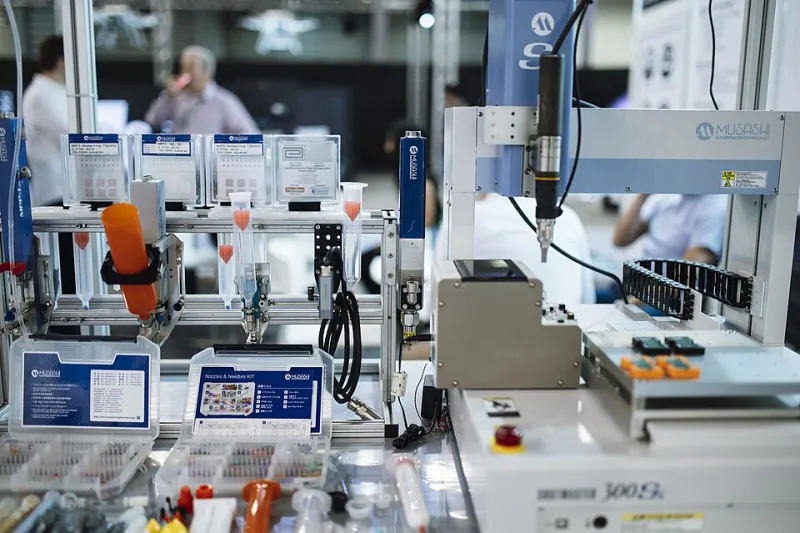
Photo: Shixart1985, CC BY 2.0, via Wikimedia Commons
There is a candid admission that most bench scientists will make when pressed: a substantial portion of their working hours is spent doing things that feel less like research and more like data entry with a lab coat on. Pipetting hundreds of samples. Re-running assays because a plate was mislabeled. Manually sorting through spreadsheets at midnight to find an anomaly buried in thousands of rows. For decades, this was simply the cost of doing science.
That calculus is beginning to change.
Across the United States, biotech and pharmaceutical research organizations are deploying integrated systems that combine robotics, machine learning, and cloud-based data infrastructure to absorb exactly this category of work. The result is not a laboratory with fewer scientists — it is a laboratory where scientists spend their time differently, and where the distance between a hypothesis and a testable result is shrinking in ways that were not feasible even five years ago.
The Anatomy of Scientific Drudgery
To appreciate what automation is displacing, it helps to be specific about what "tedious lab work" actually means in practice. Sample preparation — the process of isolating, labeling, diluting, and organizing biological specimens before any meaningful analysis can begin — is among the most labor-intensive and error-prone stages of experimental work. A single high-throughput screening campaign might require a researcher to process tens of thousands of compound-and-target combinations. Done manually, this work introduces variability, fatigue-related errors, and an enormous time cost.
Data analysis presents a parallel challenge. Modern instruments generate datasets of extraordinary complexity. A single mass spectrometry run, for instance, can produce gigabytes of raw output that must be cleaned, normalized, and interpreted before it yields actionable insight. Historically, this interpretation has required hours of manual review — hours that are unavailable for designing the next experiment or interrogating an unexpected finding.
These are not trivial inefficiencies. They represent a structural drag on the pace of discovery.
Intelligent Systems Entering the Lab
The platforms now entering research environments are meaningfully different from earlier generations of laboratory automation. Legacy robotic systems were rigid — capable of executing a defined protocol with precision, but unable to adapt when conditions changed. Contemporary systems incorporate machine learning components that allow them to recognize patterns, flag anomalies, and adjust workflows in real time.
Consider liquid handling robotics equipped with computer vision. These systems can detect when a pipette tip has been improperly seated, when a sample volume is outside expected parameters, or when a plate has been contaminated — and they can do so without human intervention. What would previously have resulted in a failed experiment, discovered hours later, is now caught and corrected within seconds.
On the data side, AI-driven analysis platforms are demonstrating the ability to process and interpret experimental outputs at a scale no human team can match. In drug discovery specifically, machine learning models trained on historical assay data can predict which compounds are likely to show activity against a given target, dramatically narrowing the experimental search space before a single physical test is run. Several US-based biotech firms have reported reductions in early-stage screening timelines measured in months, not weeks.
What Scientists Are Doing With the Time
The more consequential question may not be what automation is doing, but what it is enabling. When the mechanical and computational overhead of research is absorbed by intelligent systems, researchers describe a qualitative shift in how they engage with their work.
The most consistent theme is a return to hypothesis-driven thinking. Scientists report spending more time at whiteboards and in collaborative discussions — interrogating assumptions, designing experiments with greater intentionality, and engaging with the literature in ways that generate genuinely novel questions. The creative dimension of scientific work, which is easy to crowd out when administrative and procedural demands accumulate, becomes more accessible.
There is also an observed improvement in the quality of experimental design. When researchers are not mentally fatigued by hours of routine processing, they bring more rigor to the decisions that actually determine whether an experiment will yield meaningful data. The thinking that precedes an experiment, which is arguably its most important phase, receives the attention it warrants.
The Skill Set Shift
Automation does not reduce the demand for scientific expertise — it redirects it. The researchers who thrive in AI-augmented laboratories tend to combine deep domain knowledge with a working fluency in data science, an ability to critically evaluate computational outputs, and a comfort with iterative, systems-level thinking.
This has implications for how institutions train the next generation of scientists. Graduate programs and postdoctoral fellowships are beginning to incorporate computational biology, data literacy, and human-machine collaboration into curricula that once focused almost exclusively on bench technique. The ability to ask the right question of an AI system — to structure a query, evaluate the output critically, and know when the model is wrong — is becoming as foundational as knowing how to run a gel.
For working scientists already in the field, the transition requires a willingness to relinquish the sense of control that comes with doing things by hand. There is, for many researchers, a genuine psychological adjustment involved in trusting an automated system with work they have always done themselves. Organizations that invest in change management alongside technology deployment tend to see faster and more durable adoption.
The Broader Implication for Biotech
The laboratories that are moving most decisively in this direction are treating automation not as a cost-cutting measure but as a strategic capability — a means of compressing the discovery timeline and increasing the density of scientific output per unit of time and investment. In a field where the gap between a promising compound and a viable therapeutic can span a decade, any structural acceleration carries significant value.
The invisible assembly line running beneath the surface of modern biotech research is becoming increasingly sophisticated. What it assembles, ultimately, is not just processed samples and clean datasets. It assembles the conditions under which genuine scientific breakthroughs become more probable — and more frequent.